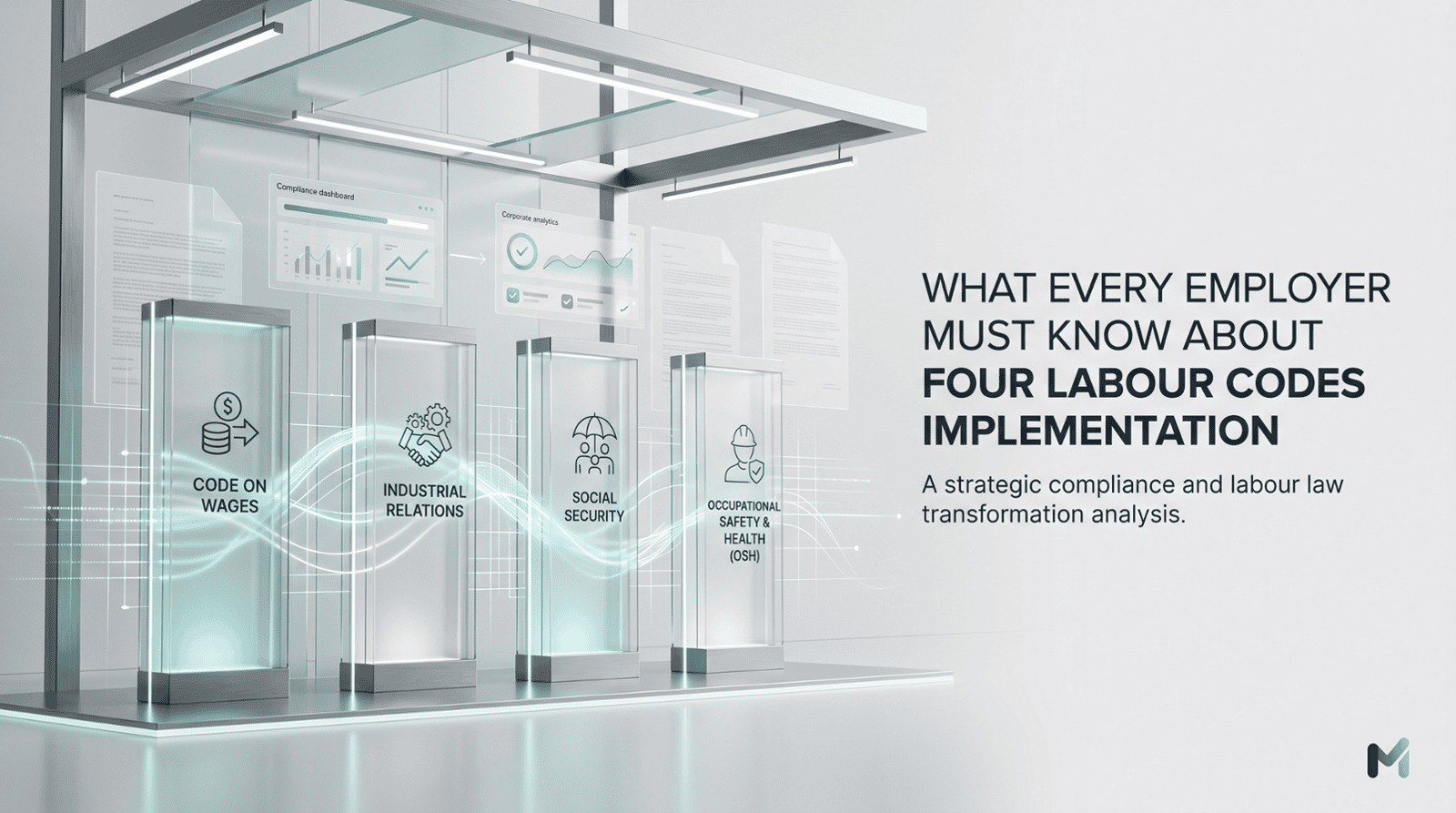
India spent seventy years governing employment under twenty-nine separate labour laws. Each law had its own rules, deadlines, definitions, inspection mechanisms, and penalties. The government has now consolidated those laws into four Labour Codes covering wages, industrial relations, social security, and occupational safety.
The old framework was difficult even for experienced labour lawyers to navigate with confidence. An HR Director managing compliance for a 400-worker manufacturing establishment had to track obligations under twelve to fifteen central statutes at the same time, each with its own compliance calendar and liability structure.
The consolidation is real. But the transition is not a simplification that an employer can observe from a distance. It requires specific decisions, specific actions, and specific investments in payroll systems, documentation, Standing Orders, contractor monitoring, welfare infrastructure, and HR practice.
Consolidation at a glance
Key fact: All four Codes have received Presidential assent. Several substantive provisions are already in force. Waiting for a single effective date is a compliance risk.
The Four Codes: What Each One Governs
Think of the four Codes as four buckets. Each bucket replaces multiple old laws, but each also creates new obligations and new cross-Code consequences.
Code on Wages
Code on Wages, 2019
Replaces the Payment of Wages Act, Minimum Wages Act, Payment of Bonus Act, and Equal Remuneration Act. It applies to every employer of any size.
IR Code
Industrial Relations Code, 2020
Replaces the Industrial Disputes Act, Trade Unions Act, and Industrial Employment Standing Orders Act. Its most visible change is the 300-worker threshold.
Social Security
Code on Social Security, 2020
Replaces nine laws including EPF, ESIC, Gratuity, and Maternity Benefit. It extends coverage to gig and platform workers.
OSH Code
OSH Code, 2020
Replaces thirteen laws including the Factories Act, Contract Labour Act, and Inter-State Migrant Workmen Act.
| Code Tag | Name and What It Replaces | Website Series Status |
|---|---|---|
| Code on Wages | Code on Wages, 2019. Replaces Payment of Wages Act, Minimum Wages Act, Payment of Bonus Act, and Equal Remuneration Act. | 2 articles published. 4 min + 9 min read. |
| IR Code | Industrial Relations Code, 2020. Replaces Industrial Disputes Act, Trade Unions Act, and Industrial Employment Standing Orders Act. | 1 article published. 11 min read. |
| Social Security | Code on Social Security, 2020. Replaces EPF Act, ESIC Act, Payment of Gratuity Act, Maternity Benefit Act, and five others. | 2 articles planned. Coming 28 April. |
| OSH Code | Occupational Safety, Health and Working Conditions Code, 2020. Replaces Factories Act, Contract Labour Act, Inter-State Migrant Workmen Act, and ten others. | 2 articles planned. Coming 12 May. |
Code on Wages, 2019
| Old laws replaced | Payment of Wages Act · Minimum Wages Act · Payment of Bonus Act · Equal Remuneration Act |
|---|---|
| Who it applies to | Every employer of any size. There is no minimum worker threshold. |
| Core change 1 | Single unified definition of wages across all four Codes. |
| Core change 2 | Two-tier minimum wage: Central floor wage plus state minimum wage. |
| Core change 3 | Universal payment timeline for wages. |
| Core change 4 | Statutory bonus obligation with updated calculation base. |
| Critical rule | Excluded pay components such as HRA and allowances cannot exceed 50 per cent of total remuneration. If they do, the excess is treated as wages for PF, overtime, bonus, and retrenchment simultaneously. |
- Website Article 1: What the Code on Wages Actually Defines as Wages.
- Website Article 2: The 50 Per Cent Rule Under the Code on Wages.
Industrial Relations Code, 2020
| Old laws replaced | Industrial Disputes Act · Trade Unions Act · Industrial Employment Standing Orders Act |
|---|---|
| Who it applies to | Establishments crossing the 300-worker threshold for key provisions. |
| Core change 1 | Retrenchment and closure prior-permission threshold raised from 100 to 300 workers. |
| Core change 2 | New Standing Orders framework that must be reviewed, revised, or re-certified. |
| Core change 3 | Trade union recognition and collective bargaining framework updated. |
| Core change 4 | Dispute resolution mechanism revised. |
| Key risk | A domestic inquiry conducted under unreviewed Standing Orders is procedurally vulnerable. |
- Website Article 1: The 300-Worker Threshold That Will Reshape Retrenchment.
- Website Article 2: Standing Orders Under the IR Code, coming soon.
Code on Social Security, 2020
| Old laws replaced | EPF Act · ESIC Act · Payment of Gratuity Act · Maternity Benefit Act · five others |
|---|---|
| Who it applies to | Establishments with 20+ workers for PF and ESIC. New gig and platform worker provisions apply regardless of that threshold. |
| Core change 1 | Social security extended to gig workers and platform workers for the first time. |
| Core change 2 | Portable benefits through the Universal Account Number. |
| Core change 3 | Principal employer liability for contractor PF and ESIC defaults is automatic, regardless of knowledge. |
| Core change 4 | Aggregators must register and facilitate registration of platform workers. |
| Gig economy rule | Even if the welfare fund scheme has not been notified in a state, the registration obligation is already in force. |
- Website Article 1: Gig Workers, Contractors and the Obligations Your Board Has Not Been Briefed On, coming 28 April.
- Website Article 2: How the Social Security Code Changes Your Contract Labour Obligations, coming 28 April.
OSH Code, 2020
| Old laws replaced | Factories Act · Contract Labour Act · Inter-State Migrant Workmen Act · Building and Other Construction Workers Act · nine others |
|---|---|
| Who it applies to | Manufacturing and industrial establishments, with specific thresholds for welfare provisions. |
| Core change 1 | Overtime calculated at 2× Code-correct wages, not just basic salary. |
| Core change 2 | Crèche threshold changed from 30 women workers to 50 total workers. |
| Core change 3 | Welfare officer threshold changed from 500 workers to 250 workers. |
| Core change 4 | Safety Committee, health register, and first-aid-box contents updated. |
| Key risk | Most payroll systems still calculate overtime on basic salary. That is wrong under the OSH Code. |
- Website Article 1: The Overtime Provision Your Payroll System Is Not Calculating Correctly, coming 12 May.
- Website Article 2: The Welfare Provisions Under the OSH Code, coming 12 May.
The Implementation Reality: What Is in Force and What Is Not
The most consequential misunderstanding about the Four Labour Codes is the belief that the Codes are not yet in force because state governments have not completed their rule notifications. This belief is incorrect, and acting on it has produced accumulated compliance liabilities that Mintskill’s audit work consistently uncovers.
The Central Government has enacted all four Codes. They received Presidential assent between 2019 and 2020. Several sections of each Code have been notified as effective at the Central level. The substantive provisions — the wage definition, the retrenchment threshold revision, the gig worker registration requirement, the overtime wage calculation methodology — are in force at the Central level. They are not waiting for state notification.
State governments must notify rules for operational implementation. The detailed procedural rules, such as forms, registers, applications, and inspection procedures, require state-level notification. Until a state notifies its rules, the old statute’s procedural framework continues to apply under transitional provisions.
The practical implication is clear: incomplete state rule notification cannot be used as a basis for deferring compliance on substantive provisions. The wage definition, the fifty per cent ceiling, the 300-worker retrenchment threshold, the gig worker registration requirement, and welfare fund contribution architecture are operative now. State-level deferral applies only to procedural details.
The Cross-Code Architecture: How the Four Codes Interact
The four Codes are not independent frameworks. They share a definitional architecture that creates interactions between them. A decision made under one Code affects compliance under three others.
The wage definition is the common thread
The Code on Wages defines wages. That same definition is used by the Code on Social Security for PF contributions, by the OSH Code for overtime rates, and by the IR Code for retrenchment compensation. A breach of the fifty per cent ceiling creates liabilities under all four Codes simultaneously.
| Code | Obligation Using Wage Definition | Liability Created by Ceiling Breach |
|---|---|---|
| Code on Wages | Minimum wage compliance | Minimum wage shortfall for workers in lower grades |
| Code on Wages | Statutory bonus | Bonus calculated on a base that is too low |
| Code on Social Security | PF contribution | PF shortfall on the employer and employee side |
| OSH Code | Overtime rate | Overtime underpayment across every overtime-working employee |
| IR Code | Retrenchment compensation | Compensation calculated on a base that is too low |
One breach, four consequences: One breach of the 50 per cent ceiling creates liabilities under all four Codes at once — wages, PF, overtime, and retrenchment compensation.
Worker classification interacts across three Codes
How a worker is classified — permanent, fixed-term, contract, gig, or platform — determines which obligations apply under each Code. A fixed-term worker classified without reference to the IR Code’s Model Standing Orders may be entitled to different benefits than the employment contract provides. A contract worker whose principal employer has not tracked ECR compliance creates liability under the Code on Social Security. A gig worker who has not been registered creates a registration default. A worker misclassified as a contractor when legally an employee attracts regularisation risk under the OSH Code and retrenchment compensation liability under the IR Code.
The threshold architecture creates step-changes
Each Code has worker-count thresholds above which specific obligations apply. These step-changes are not always at the same number and do not always interact intuitively.
| Worker Count | Code on Wages | IR Code | Social Security Code | OSH Code |
|---|---|---|---|---|
| 10+ | All obligations apply | — | POSH / Grievance Committee | — |
| 20+ | — | — | PF and ESIC applicability | — |
| 50+ | — | — | — | Crèche obligation |
| 100+ | Canteen obligation | — | — | Canteen obligation |
| 250+ | — | — | — | Welfare officer |
| 300+ | — | Prior permission for retrenchment; Standing Orders | — | Safety Committee |
| 500+ | — | Safety Committee | — | Ambulance room; Safety officer |
Example: an establishment growing from 240 to 310 workers crosses the 250-worker welfare officer threshold and the 300-worker retrenchment permission and Standing Orders threshold simultaneously. Governance infrastructure for the post-300 environment should be built before the threshold is crossed.
The Seven Most Material Implementation Obligations
The Four Labour Codes create dozens of obligations for manufacturing and industrial service establishments. These seven are the most material because they create the largest financial liability, require the longest lead time, or are most frequently in violation.
Wage Definition and 50% Ceiling Audit
What: Map your CTC structure against the Code on Wages definition. Excluded components such as HRA, travel, food allowances, and similar components must not exceed 50 per cent of total pay.
Why it matters: If they do, the excess counts as wages for PF, bonus, overtime, and retrenchment simultaneously.
Financial risk: PF damages up to 25 per cent per annum on shortfalls outstanding more than six months.
Lead time: 2–4 weeks for audit, 1 quarter for payroll reconfiguration, 3–6 months for CTC restructuring.
Full methodology: PN-03 — The Three-Step Wage Audit.
Minimum Wage Compliance on Code-Correct Wages
What: Recheck minimum wage compliance using Code-correct wages, not just basic salary.
Why it matters: You may pass the test on basic salary but fail on Code-correct wages, especially for unskilled and semi-skilled workers in Zone A and Zone B geographies.
Financial risk: Compensation up to 10 times the shortfall amount. Shortfalls accrue every payroll run.
Lead time: Fix by the next payroll run after audit identifies the gap.
Standing Orders Review and Certification Decision
What: Review existing certified Standing Orders against the IR Code and decide whether to retain, revise and re-certify, or transition to Model Standing Orders.
Why it matters: Domestic inquiries, disciplinary procedures, fixed-term employment provisions, and contested terminations depend on this framework.
Lead time: Gap analysis 2–4 weeks. Re-certification 3–6 months.
Full methodology: LC-IR-02 — Standing Orders Under the IR Code.
Contractor PF and ESIC Monitoring
What: Implement monthly ECR confirmation as a payment condition for contractors. Maintain headcount cross-verification and a contractor liability register.
Why it matters: Principal employer liability under Section 41 is automatic when a contractor defaults, regardless of whether the principal employer knew about it.
Lead time: Contract amendments 1 month. Full monitoring architecture 2 months.
Full methodology: LC-SS-02 — Contract Labour, PF and ESIC.
Payroll Reconfiguration for Overtime
What: Update payroll to calculate overtime on Code-correct wages, not basic salary.
Why it matters: Most Indian payroll systems currently get this wrong. Every overtime-worked month creates a shortfall.
Lead time: System reconfiguration 1–2 weeks. Back-liability calculation 2–3 weeks.
Full methodology: LC-OSH-01 — The Overtime Provision.
Welfare Provisions Audit
What: Verify revised thresholds for crèche, welfare officer, Safety Committee, health register, and first aid.
Why it matters: You may have crossed a new threshold without realising it.
Lead time: Audit 2–3 weeks. Welfare officer appointment 1–2 months. Crèche establishment 2–4 months.
Full methodology: LC-OSH-02 — Welfare Provisions Under the OSH Code.
Gig and Platform Worker Registration
What: If you engage workers through a digital platform, register as an aggregator and facilitate platform worker registration.
Why it matters: Registration obligation is in force now. Welfare fund contribution of 1–2 per cent of attributable turnover will apply when schemes are notified.
Lead time: Registration immediate. Worker mapping 2–4 weeks. Contribution infrastructure 2–3 months.
Full methodology: LC-SS-01 — Gig Workers and Platform Labour.
The Implementation Sequence: What to Do First
These seven obligations cannot all be addressed simultaneously. Some require legal guidance, payroll system changes, documentation, contractor renegotiation, or collective bargaining. The sequence matters.
Month 1 · Diagnose
Conduct the wage definition audit
This single exercise reveals the exclusion percentage, minimum wage position, PF back-liability, bonus shortfall, and overtime calculation error. Do not begin payroll changes until the audit is complete.
Month 2 · Correct
Correct immediate payment obligations
Minimum wage shortfalls must be corrected before anything else because they accrue cost in every payroll run.
Month 3 · Structural Fixes
Reconfigure payroll and contractor monitoring
Reconfigure payroll for overtime and PF simultaneously because both use the same Code-correct wage base. Amend contractor agreements to include monthly ECR confirmation as a payment condition.
Month 4 · Governance
Make Standing Orders and welfare decisions
Make the Standing Orders decision with legal counsel. Conduct the welfare provisions audit. Map gig and platform workers and register as aggregator where applicable.
Month 5–6 · Back Liability
Develop the disclosure and provisioning plan
Develop the EPFO self-disclosure plan with legal counsel. Present PF and bonus back-liability to the CFO with a provisioning recommendation.
Month 6+ · CTC Restructuring
Begin the long-lead CTC restructuring process
Bring excluded components below the fifty per cent ceiling. This cannot reduce take-home pay unilaterally and may require notice, documentation, and collective bargaining. Plan for a 6–9 month horizon.
Implementation reality: The implementation sequence takes six months. The accumulation of back-liability from deferring it takes exactly as long as the deferral does.
The Cost of Implementation vs. the Cost of Audit Discovery
The implementation of these seven obligations carries a cost. Audit or inspection discovery of the same obligations unaddressed carries a significantly higher cost. The difference is not primarily financial, though interest, damages, and back-liability can be material. The more significant difference is strategic.
An establishment that self-identifies, self-corrects, and self-discloses compliance gaps is in a fundamentally different position with enforcement authorities than one found in violation by an inspector. The EPFO’s enforcement posture for voluntary disclosures — organisations that come forward with calculated shortfalls, payment plans, and evidence of remediation — is systematically more favourable than its posture for contested demands.
The organisations investing in Four Labour Codes implementation now are not doing so because they fear inspection. They are doing so because implementation, done properly and in sequence, is less expensive, less disruptive, and strategically more defensible than the alternative.
The Complete Four Labour Codes Series on This Hub
This article is the employer’s overview. The detailed practitioner analysis for each Code and each obligation is available in the Four Labour Codes series published on the MintSkill Insights hub.
| Code Tag | Article Title | What It Covers | Status |
|---|---|---|---|
| Code on Wages | The Wage Structure Problem Most Manufacturers Do Not Know They Have | 50% ceiling, wage definition, CTC mapping | 2 articles live |
| IR Code | The 300-Worker Threshold That Will Reshape How You Manage Retrenchment | Retrenchment rules, Standing Orders, union recognition | 1 article live |
| Social Security | Gig Workers, Contractors and the Obligations Your Board Has Not Been Briefed On | Gig worker registration, contractor PF/ESIC liability | Coming 28 April |
| OSH Code | The Overtime Provision Your Payroll System Is Not Calculating Correctly | Overtime recalculation, welfare thresholds, safety provisions | Coming 12 May |
Code on Wages
- What the Code on Wages Actually Defines as Wages — Article 1 of 2.
- The 50 Per Cent Rule Under the Code on Wages — Article 2 of 2.
Industrial Relations Code
- The 300-Worker Threshold That Will Reshape Retrenchment — Article 1 of 2.
- Standing Orders Under the IR Code — Article 2 of 2.
Code on Social Security
- Gig Workers, Platform Labour and the Obligations Your Board Has Not Been Briefed On — Article 1 of 2.
- How the Social Security Code Changes Your Contract Labour Obligations — Article 2 of 2.
OSH Code
- The Overtime Provision Your Payroll System Is Not Calculating Correctly — Article 1 of 2.
- The Welfare Provisions Under the OSH Code — Article 2 of 2.
Supporting Practice Notes
- The Three-Step Wage Audit — PN-03.
- How to Read a PE Portfolio Company’s HR Risk Profile — PN-04.
Summary: Three Things to Remember
- The 50% ceiling is the most consequential rule. One breach creates liability under all four Codes at once — wages, PF, overtime, and retrenchment compensation simultaneously.
- The Codes are already in force. The substantive obligations are operative now. State rule notification deferral applies only to procedural details.
- Self-identify before you are found. Organisations that self-disclose and remediate are treated systematically more favourably by EPFO and labour courts than those found in violation.
If your organisation has not yet conducted a structured Four Labour Codes implementation review, the review should cover wage definition, minimum wage compliance, Standing Orders, contractor monitoring, overtime reconfiguration, welfare provisions, and gig worker registration.
Request an Implementation Review