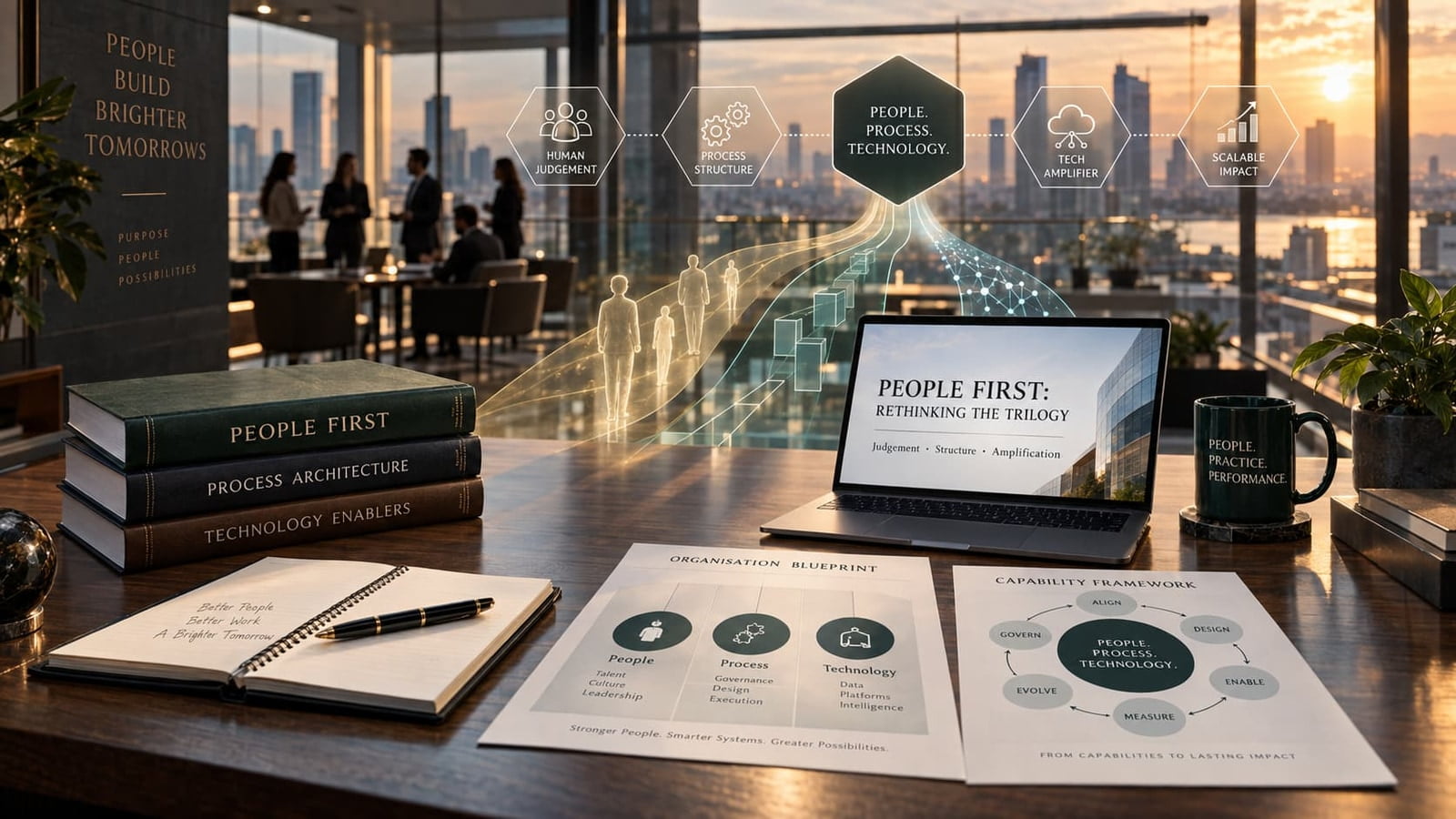
Every organisation is built on three pillars: People, Process, and Technology. When these three are well aligned, the results can look remarkable. Delivery becomes consistent, decisions get faster, and the organisation starts to run with a rhythm that feels almost effortless from the outside.
The debate that founders, CEOs, and CHROs keep returning to is one of sequence. When resources, attention, and investment are limited (and they always are), where should the emphasis go first? Do we build the process before we hire? Do we invest in the platform before we build the team? Or do we start with people and let process and technology follow?
Our view at Mintskill is clear: people come first.
The Soul and the Skeleton
Process and technology give an organisation its structure. They define how work moves, who is accountable for what, and what tools support the effort. This structure matters. Without it, even talented teams operate with friction, duplication, and inconsistency.
But structure alone does not create outcomes. People are what give an organisation its judgement, its adaptability, and its will to solve problems that no process anticipated and no system was configured to handle.
"Process and technology form the skeleton. People remain the soul. A skeleton without a soul does not move. It does not respond, decide, or care about the outcome."
— Mintskill Strategic HR Practice
This is not a dismissal of process or technology. It is a statement about dependency. Process design requires people who understand the work well enough to design it correctly. Technology requires people who can configure it, interpret its output, and know when to override it. Neither exists or improves on its own.
The Aeroplane Example: Why Autopilot Needs the Pilot
Modern aircraft are equipped with autopilot systems capable of handling large parts of a flight, including takeoff assistance, cruise navigation, and in some cases, landing. The technology is precise, tested, and trusted. Yet no airline puts a plane in the sky without a highly trained, experienced pilot in the cockpit.
The reason is straightforward. Autopilot performs well within known parameters. It executes what it has been designed to execute. What it cannot do is exercise judgement in a situation the system was never built to anticipate: sudden weather changes, mechanical anomalies, or split-second decisions that carry human consequence.
That capability sits with the pilot, built through years of training, experience, and the kind of instinct that no system can replicate.
This is the exact relationship organisations should have with their own process and technology investments. Systems handle the known, the repeatable, and the measurable extremely well. People handle everything else, which in most organisations, is still the larger and more consequential part of the work.
What This Means for the Way Organisations Invest
Founders and CEOs often approach organisation building the way they approach product building: define the system first, then plug people into it. This instinct is understandable. Systems feel more controllable. Process documents can be written in a week. Technology platforms can be selected and deployed on a project timeline. People, on the other hand, take longer to identify, develop, and retain.
But this is precisely why the sequence matters. An organisation that invests in capable people first tends to build the right process almost as a byproduct, because capable people identify what is actually needed rather than what looks correct on paper. An organisation that starts with process or technology and backfills people later often ends up with a structure built for a workforce that does not yet exist, or worse, forces good people into a structure that was never designed with their strengths in mind.
| Dimension | Systems-First Approach | People-First Approach (Mintskill Model) |
|---|---|---|
| Sequence | Process & tools built first; talent backfilled into predefined templates | Top capability hired first; processes co-architected around strengths |
| Adaptability | Fragile when real-world edge cases break standard operating procedures | Resilient; sound human judgement navigates unforeseen volatility |
| Technology Adoption | High friction; platforms imposed without frontline user alignment | Organic buy-in; tech deployed as an amplifier for existing capability |
| Scalability | Rigid bureaucracy that slows down decision velocity over time | Dynamic rhythm with high ownership, consistency, and velocity |
Direct Implications for CHROs
For CHROs in particular, this has direct implications for how talent, capability building, and organisation design get prioritised. It means:
- Hiring decisions should be treated as structural decisions, not staffing decisions. Who joins the organisation shapes what kind of process and technology will actually work.
- Capability building deserves the same rigour as system implementation. A new platform rollout gets a project plan, a budget, and a timeline. Building the human capability to use it well often does not get the same treatment, and this is where many technology investments fall short of their intended outcome.
- Process should be designed around how capable people actually work, not around an idealised version of the role. Process built without this grounding tends to be followed on paper and worked around in practice.
The Trilogy Still Needs All Three
None of this suggests that process and technology are secondary concerns. An organisation with excellent people and no process will struggle to scale, because good judgement does not substitute for consistency at volume. An organisation with excellent people and no technology will struggle to compete, because manual effort has limits that platforms do not.
The point is not that process and technology matter less. It is that they matter differently. They are amplifiers. They take what people are already capable of and extend its reach, its consistency, and its speed. They cannot create capability that was not there to begin with, and they cannot exercise judgement on behalf of the people who are meant to use them.
Organisations that get this sequence right tend to build something durable: a workforce that owns its process rather than merely following it, and that uses technology as a tool rather than depending on it as a substitute for thinking. That combination is difficult to build quickly, but once in place, it is equally difficult for competitors to replicate.
Mintskill HR Solutions LLP works with founders, CEOs, and CHROs to build organisations where people, process, and technology are structured to work together, in that order of priority.
Talk to Our Practice →